
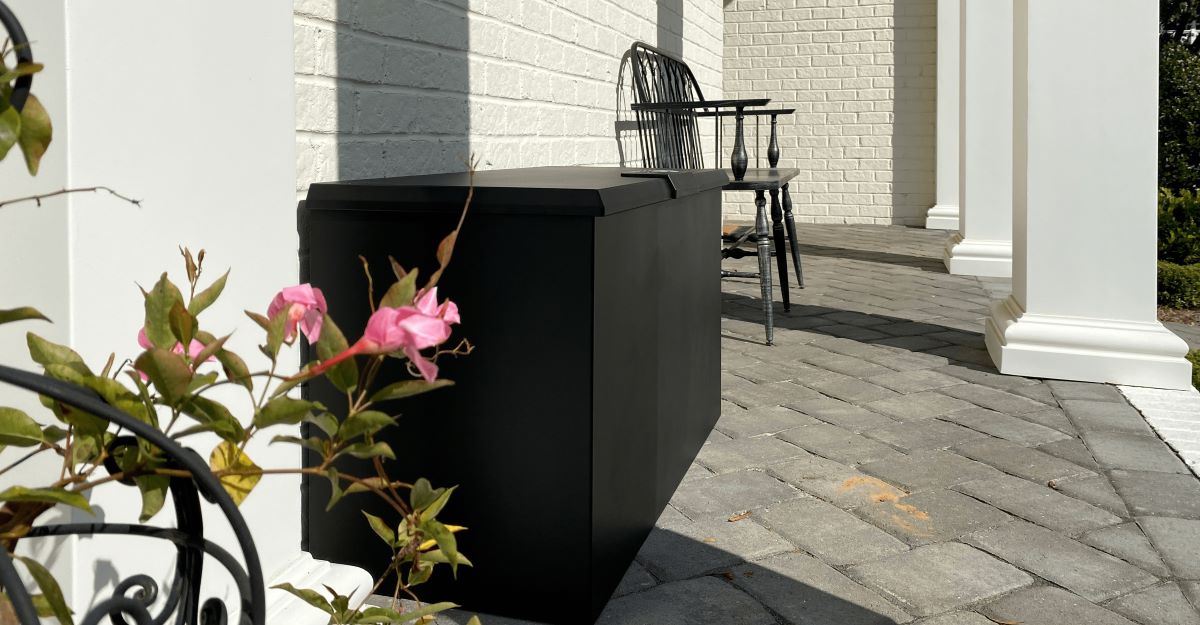
The American mailbox hasn't changed in 100 years. The volume of stuff arriving near it has tripled over the last decade. Smart parcel box new construction is the quiet shift builders are making this year — and the buyers walking your model homes are already expecting it.
The Infrastructure Mismatch at the Front Door
The average U.S. household now receives 65 packages per year, and Statista projects U.S. parcel volume to clear 28 billion shipments in 2026 alone. The mailbox at the curb was designed for letters. The doorstep was designed for a Sunday newspaper. Neither was designed for a $400 monitor in a 24-inch box arriving on a Tuesday afternoon.
That gap is what every new homeowner discovers the day they move in. The address change goes through, and deliveries start arriving. The porch immediately becomes the weak link in a brand-new home.
Builders who close that gap on the spec sheet — before the first family unpacks — are pulling ahead of those who don't.
What Today's New-Home Buyers Actually Expect
Buyer expectations have shifted faster than spec sheets have. The National Association of Home Builders' annual buyer-preference research consistently shows secure storage and tech-enabled features ranking among the most-wanted additions in homes under $750K. Package security specifically has climbed every year of the survey since 2019.
Realtors are seeing the same shift in showings. National Association of Realtors data on buyer concerns places "safe package delivery" in the same conversation as garage door openers and smart thermostats — features that move from "nice to have" to "of course it has that" in a single market cycle.
When a buyer walks into a model home in 2026 and sees a Loxx Boxx already installed at the front entry, two things happen. They picture their life in the house, and they stop comparing the home to the one down the road that doesn't have one.
The Amenity Calculus: Why Parcel Infrastructure Closes Deals
Builders don't add features for the sake of features. They add features that change buyer decision-making. Smart parcel infrastructure does three things at once:
It differentiates the home from comparable inventory. In a market where six listings within a mile look nearly identical on Zillow, a permanently installed smart parcel box is the kind of detail that gets photographed and shared.
It anticipates HOA and CC&R conversations before they arise. Master-planned communities are increasingly including parcel-storage standards in their covenants, and developers who pre-spec a uniform solution avoid the messy retrofit fight a year later.
It supports the long-term sales story. A home buyer in 2026 is also a home seller in 2031. Builders who position their inventory as already future-proofed for delivery infrastructure are protecting resale value while closing the first sale.
How Developers Are Integrating Loxx Boxx Into New Builds
The Loxx Boxx Builders & Developers program is designed for the way new construction actually happens — phased lots, model home installs, master-planned communities, and townhome rows. Three integration paths cover most projects:
Per-home spec: The most common path. A Loxx Boxx is installed alongside the mailbox at closing, sized to the home's expected occupancy. Solar charging eliminates wiring runs, so there's no need to coordinate with the electrical sub.
Model home demonstration: Developers install a Loxx Boxx in the model and offer it as a buyer upgrade or standard feature. Sales offices report it as one of the most-photographed details by visiting families.
Community-wide standardization: For master-planned developments, uniform parcel infrastructure across the community supports HOA enforcement and avoids the aesthetic patchwork of homeowners picking different solutions independently.
All three integrations work with the standard Loxx Boxx product line — color-matched options for the architectural style, multiple sizes for household type, and the Boxxie app handed to buyers at closing as part of the welcome packet.
The Rental and Multi-Family Adjacent Play
Builders working on rental communities and multi-family inventory face an even sharper version of the problem. Centralized package rooms create staffing burdens, locker bottlenecks, and lost-package liability — issues every property manager knows by name.
Per-unit parcel boxes shift the operational model. Each resident has dedicated, secure receiving without the property management team in the middle. Move-ins become easier. Resident retention improves on the margins that matter. Insurance conversations become clearer.
The same hardware that closes single-family deals operates the multi-family upgrade.
Quick Answers
Does Loxx Boxx work with HOA design standards?
Yes. Multiple color options, low-profile siting, and uniform installation make Loxx Boxx HOA-friendly. Most CC&Rs governing mailboxes accommodate Loxx Boxx with minimal adjustments.
What does the installation cost a builder per unit?
Per-unit pricing scales with volume, and most developers integrate the cost into the home's base price rather than treating it as an upgrade. The Developers program includes volume pricing and installation guidance.
How does this compare to a centralized package room?
Centralized rooms create staffing burdens, locker queues, and liability gaps. Per-home Loxx Boxx units eliminate the bottleneck while giving residents direct, app-controlled access to their own deliveries 24/7.
Make Parcel Infrastructure a Standard Feature
The buyers walking your model homes this fall are the same buyers who got their first "package stolen" notification last spring. They've already lived the problem. They're already looking for the solution. Spec it in.
Builders and developers can review the full program — pricing, lot-plan integration, color options, and installation guidance — on the Loxx Boxx Builders & Developers page. For active projects or volume quotes, get in touch with our team — we work with single-row infill builds and 500-unit master plans alike.
Share:
Back to School Package Delivery: How Families Are Surviving the August Surge
Why Multi-Family Communities Are Rethinking Package Delivery